Picture this. You’ve paid a decent price for a roasting joint from the supermarket. It looks good in the packet — plump, firm, reassuringly heavy. You slide it into the oven and two hours later, you lift the lid to find something half the size floating in a pale puddle of liquid. Sound familiar?
You haven’t done anything wrong. The joint has.
The Starch Secret Most Shoppers Never Know About
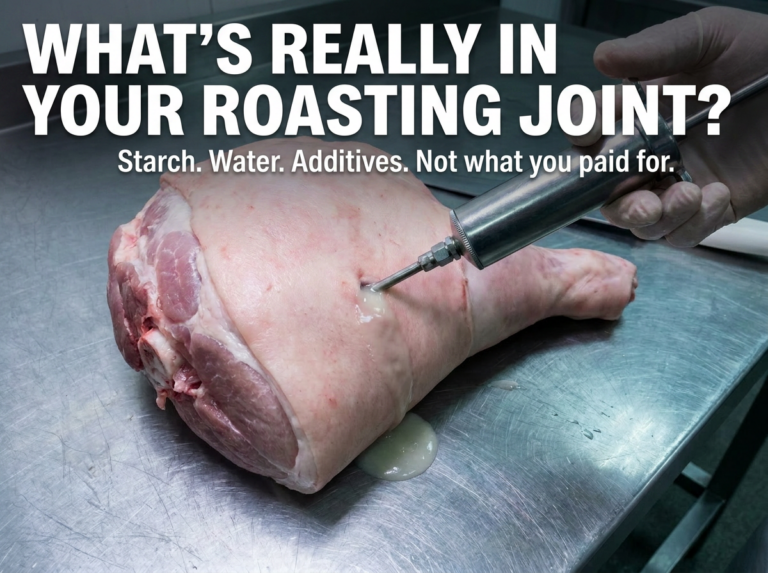
Here’s something the supermarkets don’t put on the front of the pack: many roasting joints — pork shoulders, gammon joints, rolled loins — are injected or tumbled with a brine solution containing modified starch, water, salt, and sometimes phosphates before they ever reach the shelf.
Why? Several reasons, and none of them are really for your benefit.
1. To sell you water at meat prices.
Starch binds water molecules inside the muscle tissue. That extra weight goes on the scale. You pay for it. During cooking, much of it leaves — which is why that pool of liquid appears in your roasting tin, and why the joint shrinks so dramatically.
2. To make poor-quality meat look and feel better.
Intensively reared animals, raised quickly in confined conditions, produce meat with less natural fat marbling and less developed flavour. Starch gelatinises during cooking, creating a softer, more uniform texture that masks what isn’t there.
3. To extend shelf life.
Modified starch helps the surface of the joint hold its colour and firmness for longer on the shelf — useful when your supply chain runs to days or weeks.
How It Gets In There
This isn’t a surface coating. The starch-and-brine solution is driven into the meat in one of two ways:
- Injection — needles pierce the joint under pressure, delivering the solution deep into the muscle
- Tumbling — the meat is placed in a vacuum drum with the brine and mechanically worked until the solution is absorbed
By the time it reaches you in its vacuum pack, it looks completely natural. And unless you read the small print on the label — “with added water” or “contains starch” buried in the ingredients — you’d have no reason to suspect a thing.
What the Label Tells You (If You Know Where to Look)
UK food law does require declaration if added water exceeds a certain threshold. It just doesn’t require them to put it on the front in big letters. Look at the back of many supermarket joints and you’ll find it there, in the ingredients list, often in a font that requires good eyesight and decent lighting.
Most people never look. The supermarkets know that.
What a Real Roasting Joint Looks Like
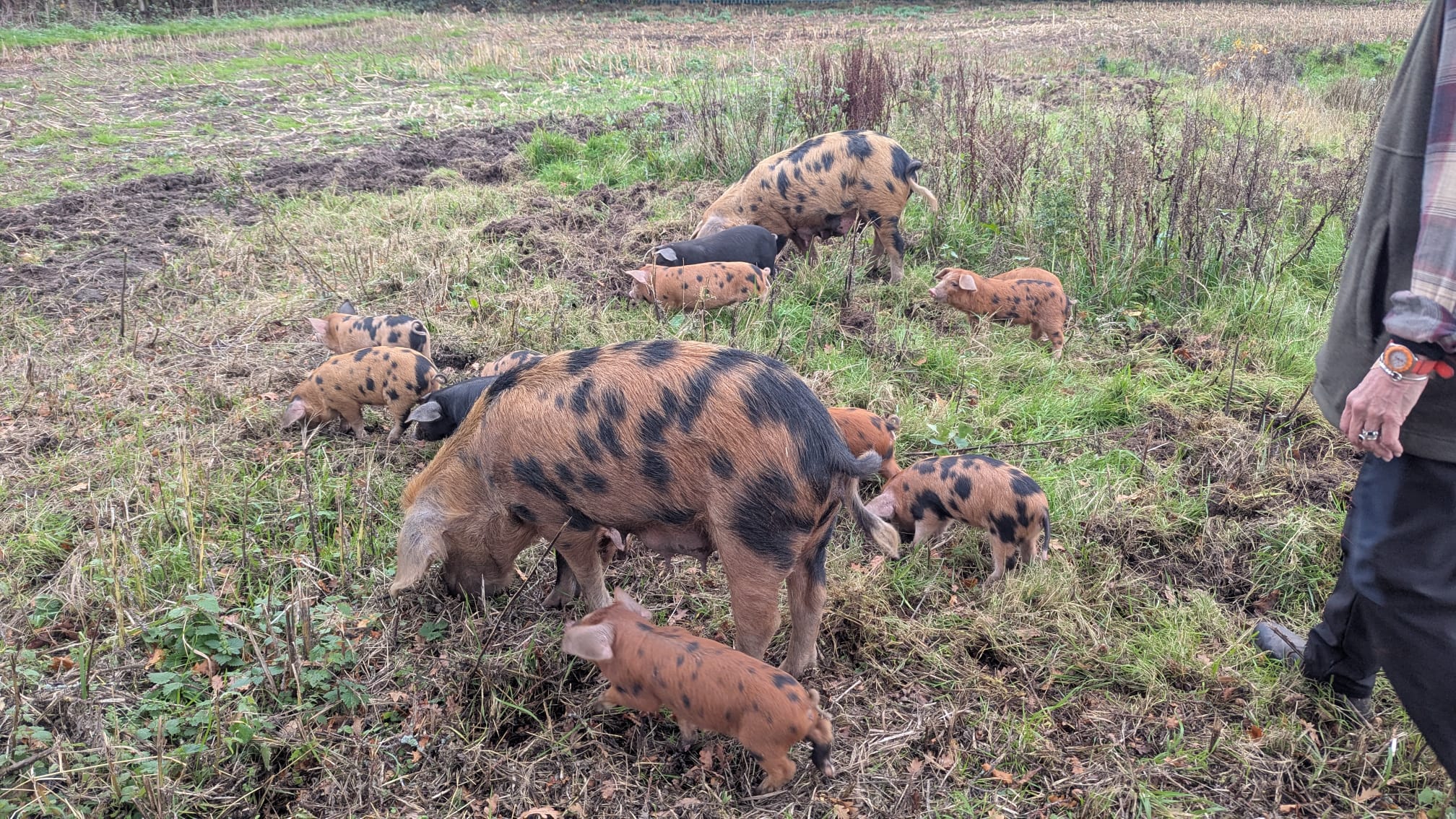
At Owl Farm, our pigs — Large Black, Oxford Sandy & Black — are raised on Cheshire pasture, living as pigs are supposed to live. Rooting. Foraging. Moving. Taking the time to grow properly.
That time is the whole point.
A heritage breed pig raised traditionally develops deep fat marbling throughout the muscle. That fat is what bastes the meat from the inside during roasting. It’s what gives you crackling that actually crackles. It’s what creates that flavour that makes people stop mid-mouthful and say “oh, that’s different”.
We don’t inject our joints with anything. We don’t tumble them. We don’t add starch, water, or phosphates. What goes in the packet is what came off the animal — nothing more.
Yes, our joints shrink a little during roasting. All honest meat does. But that shrinkage is natural moisture, not engineered water weight. The ratio of actual meat to what you started with is far better than anything that’s been through an industrial brine tank.
The Real Cost Comparison
A supermarket joint might look cheaper per kilogram. But if a third of that weight is added water that cooks off, is it really?
The joint you buy is the joint you cook. Simple as that.
Taste It for Yourself
We’re at Nantwich Market twice a week, Treacle Market once a month, and Rode Hall once a month. Come and talk to us. We’re proud of what we raise and happy to explain exactly how every cut reaches you.
Or find us online at www.owl-farm.co.uk
Because good food shouldn’t need a chemistry lesson on the label.
Owl Farm — Beyond Organic, Beyond Ordinary.